
Ask a room of senior leaders why transformations fail and you'll hear familiar answers:
- unclear strategy
- poor execution
- the wrong technology
They're all reasonable, but miss the underlying issue.
At a recent executive roundtable Breakthrough Global hosted in London, a group of senior leaders came together to talk about leading through unrelenting change. A different answer kept surfacing. One that leadership institutions like the Center for Creative Leadership are now spotlighting as well: Transformation rarely fails because of poor strategy or a lack of trying. It fails because organisations run out of energy.
Why Do 70 - 88% of Transformations Fail?
Depending on who you ask, somewhere between 70% and 88% of corporate transformations fall flat. It's a statistic we've all heard so often that it's easy to just tune it out.
If strategy were the problem, decades of sharper planning and better execution frameworks would have fixed it by now. But they haven't. The failure rate has remained stubbornly unchanged, despite massive investment in methodologies, consultants and change management tools.
What Energy-Driven Transformation pointed to, and the roundtable echoed instead was depletion. People are asked to deliver the day job, absorb a restructure, adopt new tools and believe in a new direction, often all at once. Individual and team capacity simply runs out. Employee willingness to support organisational change has dropped sharply as the sheer volume of initiatives has multiplied.
Exhausted teams don't push back out of malice. They fall back on old habits because they simply don't have the bandwidth for anything else. Leaders can be read as a lack of commitment and push harder, only to burn whatever energy is left. This is the cycle of change exhaustion.
How Has Collapsed Planning Horizons Impacted Leaders?
Many of those at the London roundtable described planning horizons of just two or three years, some only 18 months. And as recent times have proved unpredictable and for many unrelenting, constant disruptions keep rewriting the assumptions behind any plan. This leaves strategies outdated and a snapshot of what you believed six months ago.
That reshapes what leadership is for. Today’s leaders need to be agile and know when to pivot. They spend less time creating the perfect strategy and far more time nurturing the organisation’s energy, keeping momentum alive and bringing along their people across all organisational levels. Direction and objectives still matter, but energy is what carries forward.
What are the Three Phases of Sustaining Transformation?
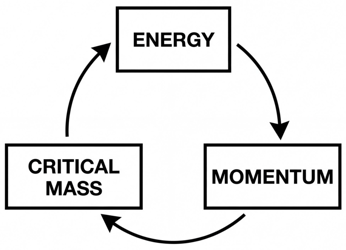
Pulling from the themes of Energy-Driven Transformation, Zannah Ryabchuk and Dr Bart Sayle outline 3 phases needed to sustain transformation:
Phase 1 is activating energy. In physics, activation energy is the minimum burst required to kickstart a chemical reaction. Organisational change works in exactly the same way. Most teams have lived through many high-concept initiatives, only for big ambitions to fizzle out. Some leaders will view this as resistance rather than earned scepticism. But as explored in Energy-Driven Transformation: Part One, every organisation also operates with an internal "energy thermostat." When leaders push for bold shifts, the system naturally pulls back to maintain its comfort zone. Overcoming that friction takes intentional leadership action to shift the collective mindset and break default patterns. This is the opportunity to step out of business-as-usual, own the vision and commit to a new trajectory.
Phase 2 is maintaining momentum. It’s easy to mistake action for achievement, but getting lost in busy being busy is not momentum. Here, teams are worn out and trajectory falls flat. Sustaining momentum takes decisive calls, but against an unpredictable landscape this can be a tall task. Instead, small consistent course corrections or One-Degree Shifts, ensure teams and organisations stay responsive rather than reactive.
Phase 3 is reaching critical mass. Think of critical mass as a chain reaction. It is the moment that the new behaviours and mindsets become self-sustaining. Leaders are at risk here of falling into the echo chamber. They assume that the message, vision and strategy has been owned by all levels. This is so often the case following a merger and acquisition. Transformation requires replacing divided mindsets into a shared identity, where people shift from following a set of instructions to owning who the organisation is becoming.
Most change initiatives are designed as though phase 1 is the whole job, or worse, that the strategy is the only focus. Instead, invest in the people who have to deliver and carry the strategy forward, and you’ll come to see transformations start delivering lasting impact.
Access C-Suite Insights
Sustaining energy, not just setting a new direction, is what carries transformation to the finish line. That's a simple idea, but it reframes the questions leadership teams ask themselves.
- Shift from "is our plan right?" to "do our people have the energy to carry it?"
- Shift from "have we communicated the change?" to "Is it landing?"
- Shift from "how do we go faster?" to "what are we doing that drains energy we'll need later?"
To help bring these perspectives to your leadership team, we have compiled key takeaways from the roundtable into a concise Executive Briefing: Leading Through Unrelenting Change. Explore these core principles along with actionable strategies from C-suite leaders that will restore and maintain organisational energy.